
Tucked into a corner of downtown Little Rock, The Weekend Theatre doesn’t look like the kind of place you’d expect to find intimate, character-driven productions that tackle difficult social issues and challenge audience perspectives.
It’s small, just about eighty seats, and easy to miss if you’re not looking for it. But that’s part of what makes it special. In a space that feels more like a shared living room than a formal venue, actors and audiences come face-to-face with stories that challenge, unsettle, and ultimately connect. However, due to its specific location, this intimate theatre comes with some unexpected neighbors.
Founded in 1991, The Weekend Theatre started with a group of people who believed central Arkansas needed more than entertainment. It needed theater that could engage audiences in something deeper. As board president Andrew Ellis explained, he was seeking a theater that didn’t refrain from exploring serious topics.
That philosophy shows up in the kinds of shows they choose. Over the years, their lineup has ranged from well-known musicals to heavy dramas that ask audiences to sit with complicated issues.
Productions like Angels in America, which follows a group of interconnected characters navigating the AIDS crisis in 1980s America, A Raisin in the Sun, a story about a Black family struggling over identity, money, and dreams on Chicago’s South Side, and The Crucible, Arthur Miller’s portrayal of mass hysteria during the Salem witch trials, aren’t just crowd-pleasers; they’re conversations. More recent work, like Sugar in Our Wounds, continues that tradition, bringing stories of oppression, resilience, and love to the forefront. That particular production drew such strong support that it sold out multiple performances and extended its run into Black History Month.
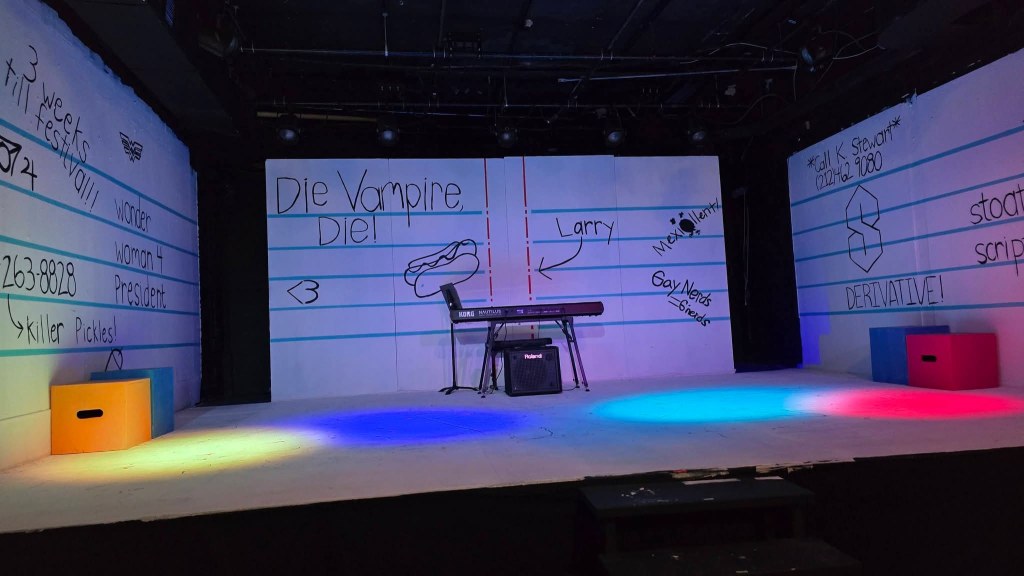
That sense of closeness carries into the performances themselves. There’s no distance between the stage and the audience, no elaborate sets to hide behind, everything feels immediate. Operating in a theatre of this size can pose some challenges for storage.
However, on the other side of the curtain, audiences are able to pay better attention to detail because of the close proximity. During a tense confrontation between two characters, you can see every flicker of hesitation or frustration on their faces, hear the strain in their voices, and even feel the silence linger in the room after a difficult line is delivered. When a character struggles, you see it up close. When a moment lands, it lands hard. The intimacy forces both performers and viewers to stay present, and that’s where the theater does its best work.

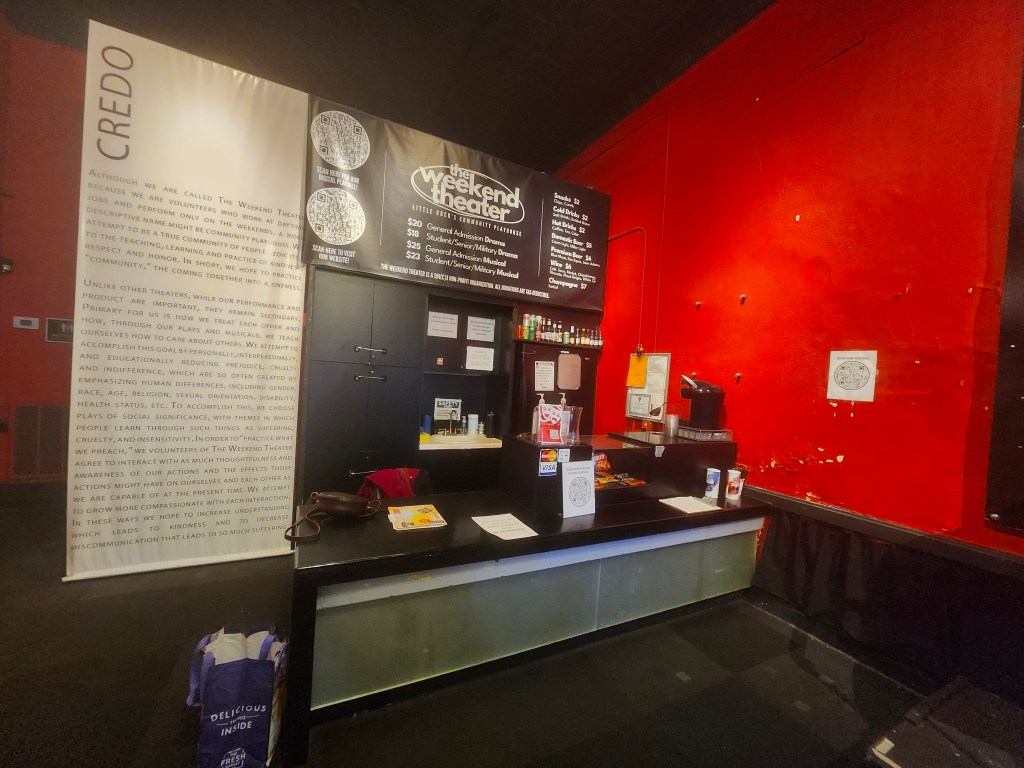
That closeness extends beyond the stage, too. Shaina Tippett, who doubles as both The Weekend Theatre’s Executive Director and Director of Marketing, emphasized the importance of community within their theatre’s identity.
What really sets The Weekend Theatre apart, though, isn’t just its size, but its purpose. From the beginning, the group has focused on producing plays that tackle difficult, often uncomfortable topics.
Unlike many theaters that prioritize polish and production value above all else, The Weekend Theatre flips that mindset. Here, the way people work together matters as much, if not more, than the final product.
That philosophy shows up in the kinds of shows they choose. Over the years, their lineup has ranged from well-known musicals to heavy dramas that ask audiences to sit with complicated issues.
Productions like Angels in America, A Raisin in the Sun, and The Crucible aren’t just crowd-pleasers; they’re conversations. More recent work, like Sugar in Our Wounds, continues that tradition, but in a way that feels especially raw and personal. Set during American slavery, the play centers on a small, chosen family living under constant threat, where even moments of safety can disappear the second someone walks through the door. As rumors of freedom begin to spread, so does a quiet sense of possibility, especially when a newcomer arrives and disrupts everything they thought they understood about survival. At its core, the story leans into the tension between danger and tenderness, following a relationship that dares to exist in a world built to crush it. Even with all that weight, the play makes space for intimacy, love, and the question of how people hold onto each other in the middle of unimaginable circumstances. That particular production clearly resonated, it sold out multiple performances and ended up extending its run into Black History Month.
Even when they produce lighter material, there’s usually something deeper underneath. The goal isn’t just to entertain, it’s to make people think.
The theater’s roots in social awareness can be traced back to its founder, Dr. Ralph Hyman. As both a psychologist and an activist, Hyman believed storytelling could shift perspectives because it places audiences inside someone else’s experience, making abstract issues feel personal, emotional, and harder to ignore. Under his leadership, the theater produced hundreds of shows, each one contributing to a larger mission of understanding and compassion. His influence is still felt today, not just in the plays chosen, but in the culture of the organization itself.
After stepping down in 2014, Hyman left behind more than a legacy of productions; he left a framework for how theater could function as a community-driven force for good. Current leadership continues to build on that foundation, keeping the focus on meaningful work while maintaining the welcoming, collaborative spirit that defines the space.
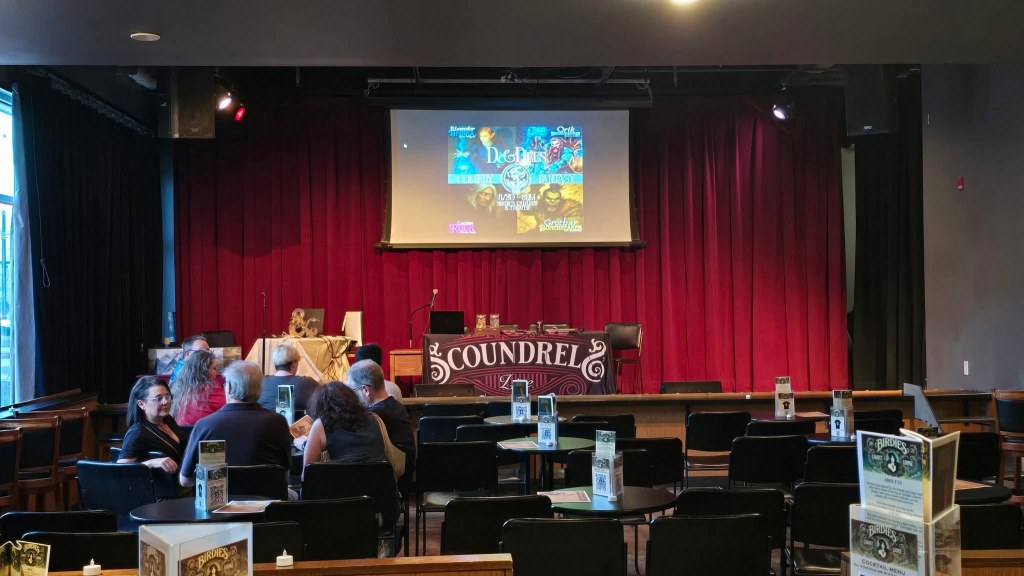
The Weekend Theatre isn’t alone in this approach. Across the river in North Little Rock, spaces like Birdies are also proving that small venues can have a big impact. These places may look completely different on the surface, but they share something important: a focus on creating an experience that feels personal and connected.
Birdie’s was created by best friends and magicians Paul Noffsinger and Paul Prater, who originally bonded over performance, storytelling, and, as they put it, beer. What started as a shared interest eventually turned into something bigger: a place where different kinds of artists could have a space to perform and be seen. That idea still shapes what Birdie’s is now. It’s not just a theater, and it’s not just a bar. It is a mix of both, built around the idea of bringing people together.
What really sets Birdie’s apart is the variety of what it offers. On any given night, it could be an improv show, a burlesque performance, a themed event, or something completely unexpected. That range keeps people coming back, not just for one kind of show, but for the experience of not knowing exactly what they’ll get. It creates a different kind of audience relationship, one that’s built more on curiosity and energy than routine.
In a lot of ways, Birdie’s and The Weekend Theatre are doing the same kind of work, just through different mediums. Both create spaces where people aren’t just passive observers, they’re present, part of the energy in the room, sharing in something that’s happening in real time. Because the scale is smaller, that connection feels more direct, less filtered.
That’s really the advantage of being small. There’s no hiding behind spectacle or big production tricks, so the focus stays where it matters, on the people in the room. The actors, the audience, the interaction between them. It creates an environment where stories don’t feel distant or abstract, they feel immediate, personal, and harder to shake once you leave.
At The Weekend Theatre, that impact isn’t accidental, it’s built into every choice they make. Each production is meant to push audiences a little further, whether that’s asking them to sit with a difficult topic, see a story from a perspective they hadn’t considered, or rethink something they thought they understood. It’s not always comfortable, and it doesn’t try to be. But that discomfort is part of the point, and part of what makes the experience stick long after the show ends. To perfectly capture that post-show feeling through music, “The World’s A Stage,” by Tenellus, truly encapsulates the aesthetic of a usual production at The Weekend Theatre.
In a world where entertainment is often reduced to quick, scrollable clips and bite-sized content, where platforms like TikTok and Instagram prioritize fast, flashy videos you can consume in seconds, The Weekend Theatre offers something completely different.
They remind us that theater doesn’t have to be big to be meaningful. Sometimes, the smallest spaces are the ones that leave the biggest impression.
Sources
https://weekendtheater.org/aboutus/
https://encyclopediaofarkansas.net/entries/weekend-theater-12192/


Leave a Reply